
By Abishanka Mukherjee 9th October 2025
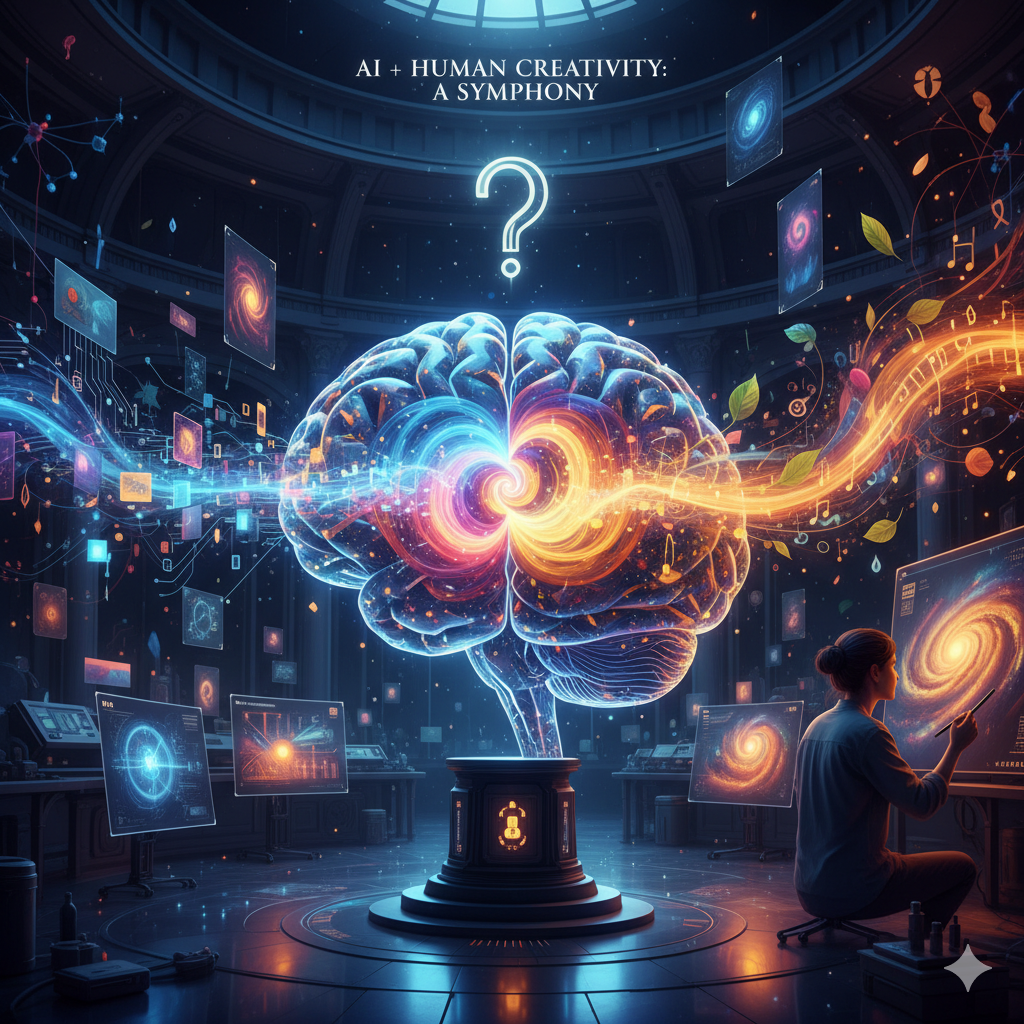
Creativity has long been seen as one of the last refuges of human uniqueness — the burst of imagination that produces a song, a painting, a business idea, or a sudden solution in the middle of the night. With AI now generating images, music, text, and designs at scale, people ask the obvious question: Can AI replace human creativity? The short answer is: Not entirely — but it’s changing what creativity looks like. Below I’ll unpack why, how, and what this means for creators, businesses, and culture.
What do we mean by “creativity”?
Before deciding whether AI can replace creativity, we need a working definition. Creativity usually involves:
- Originality — producing something new or recombining ideas in novel ways.
- Value — the result resonates emotionally, solves a problem, or achieves some goal.
- Intentionality — a purpose or context guiding the creative act.
- Subjectivity — meaning often depends on human perspectives, histories, and cultural context.
AI systems excel at recombining patterns and producing outputs that look novel. But whether those outputs carry the same intentional meaning and emotional resonance as human-made work is central to the debate.
How AI “creates” (briefly)
AI models generate outputs by learning statistical relationships from large datasets. They:
- Recognize patterns (styles, forms, structures).
- Predict next elements (words, notes, brushstrokes) given prompts.
- Optimize for objectives set by humans (likelihood, aesthetic scores, user feedback).
This process enables spectacular results: realistic images, plausible essays, catchy melodies. But it’s fundamentally different from human cognition: there’s no personal experience, inner life, moral stake, or conscious purpose behind the output.
Arguments that AI can replace creativity (partial truth)
- Scale and speed: AI can produce large volumes of polished content quickly — useful for drafts, ideation, or routine creative tasks.
- Pattern mastery: For many genres with clear rules (logo design, template-based ads, formulaic articles), AI can match or exceed average human quality.
- Accessibility: People who lack technical skill or training can generate professional-level artifacts, democratizing creative outputs.
- Cost-efficiency: Businesses can reduce production time and cost for repetitive creative tasks.
These strengths mean AI can substitute for a lot of creative labor, especially where creativity follows well-defined conventions.
Arguments that AI cannot truly replace human creativity
- Lived experience and authenticity: Human creativity often arises from personal history, trauma, joy, or cultural roots. AI lacks authentic lived experience and cannot be someone’s memory, identity, or moral compass.
- Intent and purpose: Humans intentionally pursue meaning, challenge norms, and take creative risks that may be inefficient or irrational. AI optimizes within objectives given to it; it doesn’t choose values or causes.
- Contextual judgment: Great art and innovation hinge on subtle cultural signals and ethical considerations AI may misread or ignore.
- Serendipity and failure: Human creativity embraces accidents, constraints, and failures as generative forces. AI tends to minimize “error” to conform to learned patterns.
- Relational creativity: Much human creativity is collaborative and emergent — born from communities, mentorship, and shared rituals. AI-mediated outputs often lack the social context that gives them depth.
Real-world patterns: replacement vs. augmentation
In practice, AI is neither fully replacing nor wholly powerless — it’s augmenting creativity while replacing certain roles:
- Replaced or transformed tasks: Routine design variations, background music, first drafts of marketing copy, concept art iterations.
- Augmented tasks: Brainstorming prompts, rapid prototyping, co-creation with human guidance, scaling personalized content.
- Still human-centered: Political satire with cultural nuance, deeply personal storytelling, innovations that require moral judgment or unpredictable leaps.
This hybrid reality is the most likely long-term outcome: AI performs heavy lifting; humans steer, refine, and imbue outputs with meaning.
Examples (high-level)
- Music: AI can generate melodies in a given style. But a songwriter humanizes a theme with narrative, emotional arcs, and intention tied to their life.
- Visual art: Generative images can be breathtaking, but the artist’s statement, curatorial choices, and cultural placement are what often make art significant.
- Business innovation: AI can analyze data and suggest optimizations; disruptive ideas still emerge from human insight about unmet needs and messy real-world constraints.
Ethical and practical concerns
- Attribution & ownership: Who owns AI-generated work? Who gets credit?
- Quality dilution: Flooding marketplaces with procedural content can make it harder for exceptional human creators to stand out.
- Bias & misuse: AI reflects biases in its training data; creative outputs can amplify harmful stereotypes.
- Skill atrophy: Overreliance on AI may weaken human craft over time.
How creators can thrive
- Shift toward higher-level skills: Focus on concept, curation, strategy, and storytelling — areas where human judgment matters most.
- Learn to co-create: Use AI as a partner for ideation, rapid iteration, and extension — not as a final author.
- Develop a unique voice: Distinct perspectives, lived experience, and intentionality will remain valuable differentiators.
- Own context and ethics: Be explicit about intent, attribution, and the social role of your work.
- Master new tools: Understanding and leveraging AI tools skillfully will be a creative advantage.
The future: collaboration, not competition
AI will shift the creative landscape but isn’t poised to fully replace what humans uniquely bring: moral imagination, authenticity, intentional disruption, and the messy power of lived experience. The most exciting futures are collaborative: humans setting goals and meaning, AI amplifying capacity and helping probe possibilities faster.
Conclusion
Can AI replace human creativity? Not in full measure. It can replicate patterns and accelerate many creative tasks, but it cannot be the human heart, context, or conscience that often gives creativity its deepest value. The practical truth is more useful: AI will reshape creative work — replacing some roles, augmenting many, and making new forms of creativity possible. For creators, the winning move is to embrace AI as a powerful collaborator while leaning into the uniquely human strengths that machines can’t reproduce.
Want a version tailored for your blog (shorter, SEO-optimized headline, or with images and social post lines)? I can create ready-to-publish variants — tell me which style and word count and I’ll draft it.